Free hit counter

Search This Blog

Showing posts with label automotive. Show all posts

Saturday, May 26, 2012

This Cadillac Is Powered by Linux

LOS ANGELES, California – The brand once known as the “Standard of the World” has fully embraced the Standard of Geeks for its latest play for the hearts, minds and cash of the upwardly mobile. This is the all-new 2013 Cadillac XTS, and while it certainly isn’t your great-great (great) grandfather’s Cadillac, it’s designed to appeal to everyone from octogenarians to their baby-boomer spawn, and maybe — just maybe — even you….
While the XTS’ spate of processors and controllers isn’t running the open source offspring of Linus Torvalds, the game-changing infotainment intender known as the Cadillac User Experience (CUE) is.
Buried deep within the dash is a three-core ARM 11 processor, powering two displays: one eight-inch capacitive touch screen — the first non-resistive display to come to a production car — and a second, 12.3-inch fully configurable instrument cluster mounted behind the steering wheel. Two of those cores adapt on the fly to handle voice commands powered by the same Nuance technology used by many automakers, along with Apple’s personal assistant, Siri. But with CUE, everything is processed on board.
Because of that trick bit of natural voice recognition technology, and specifically its ability to listen for commands in-line, inputting addresses and performing point-of-interest searches is easily the best we’ve ever experienced in a modern vehicle.

Rather than breaking out each portion of an address into dedicated fields, you simply have to speak an address (say, “123 Main Street, Cupertino, California”) and CUE is smart enough to recognize the entire address in one shot. More impressive is the system’s ability to take local searches — everything from “I need coffee” to navigating to a restaurant — process the voice command within a few seconds and deliver a result.
CUE is one of the most attractive infotainment systems to date
This came in particularly handy while we were trying to make our way to the test-drive lunch stop. Instead of having to look up the address, input it into the navigation system and wait for the routing to begin, we simply said the name of the restaurant and seconds later it was dialed into the nav. And even though we stumbled on our words, pausing momentarily and stuttering in the process, it still recognized where we were trying to go. That’s a first and it’s something we can’t wait to see proliferate throughout other production vehicles.
This same functionality extends to the app and audio integration, allowing the driver to say, “Play Rolling Stones Radio” in Pandora or “I want to listen to 88.5″ without ever having to touch the screen, twist a knob or punch a button.
Which is good, since there are few knobs or buttons to speak of.
Images: Cadillac
Aside from the redundant controls on the steering wheel (and there are several), the entire center panel is made up entirely of capacitive, chrome-clad touch controls. The lower panel — which mechanically tilts upward to reveal a hidden compartment for stowing a phone, along with two USB ports for plugging in your mobile, MP3 player or thumb drive — houses controls for volume, climate, seat heating and cooling, plus “home” and “power” controls. Unfortunately, the very nature of capacitive switchgear means there’s a subtle lag between pressing a “button,” registering the input, delivering a haptic pulse, sending said input to the system and then eliciting a change in fan speed or volume level. It’s the same gripe we have with the MyFord Touch system — further proof that good ol’ knobs are still the best way to go, despite their lack of gee-wizardry.
And this same lack of responsiveness can occasionally be felt when navigating the eight-inch central display.
While the overall polish of the system is more than enough to impress, there’s still a perceivable lack of smoothness and immediacy
While the overall polish of the system is more than enough to impress, there’s still a perceivable lack of smoothness and immediacy when switching through menus, navigating pages and swiping between screens. The situation is exacerbated by the occasional misinterpreted press on the screen, a product of small touch points that don’t always register where you expect them.
Equally jarring is CUE’s ability to detect when your hand moves within eight inches of the screen, which then pulls up a series of configurable virtual buttons for everything from radio presets to frequently navigated addresses. When you pull away, the controls fade into the background.
It’s impressive to watch the system recognize your hand’s proximity to the screen and then display a series of controls that would make the display look otherwise cluttered, but having some of these items statically placed seems like a more intelligent user interface choice for frequently selected options. That’s one of the many reasons Cadillac is providing an iPad with every 2013 model to help consumers navigate the new system.
Image: Cadillac
General smoothness aside, CUE is one of the most attractive infotainment systems to date, mixing 3-D graphics with color icons and a beautifully rendered mapping display. And while the app selection is limited for now, with only Pandora, Stitcher and a pre-installed OnStar app available at launch, Cadillac tells Wired that an app store is on the way. Java and HTML5 are make up the core frameworks, so once developers are granted access to the SDK, Cadillac expects as many as 30 apps to be available within the next year.
But while we had our issues with CUE (growing pains, we’re sure), the configurable display that takes the place of traditional gauges behind the steering wheel never failed to impress.
Four different designs are available, beginning with a simple, three-gauge cluster with engine revs on the left, speed in the center and fuel, coolant and phone/navigation/audio on the right. It’s the most traditional display and what most drivers will feel immediately comfortable with.
The second display nixes all the round gauges for a digital speedo at the top, navigation instructions below and other assorted information flanking the sides, while an even more simple display – obviously aimed at some of Cadillac’s aging drivers – only shows speed, fuel level and a few other must-haves.
Finally, there’s a more enthusiast-friendly option, with an oversized tachometer and speedo, partnered with a 3-D rendering of the vehicle along with tire pressures, engine temp, navigation and audio controls, all displayed clearly and vividly for the driver. We stuck with the latter during the majority of our drive.
All this tech is pretty useless if the vehicle surrounding it isn’t up to snuff. And here Cadillac has a winner, even though the XTS won’t send chills down the spines of Audi, BMW and Mercedes-Benz.
The exterior is an odd blend of bold and bland, while the interior is a beautifully appointed mix of leather, wood and contrast stitching (the purple thread in the Platinum models has to be seen to be appreciated). There’s ample room for four people (five in a pinch), with leg and shoulder room abound, and a thoughtful, conservative approach to luxury that’s been utterly lacking from most American automakers. The XTS feels a bit more Japanese than German in execution, but injects a bit of emotion into an otherwise bland segment of upmarket rides.
The overall length is on par with Audi’s range-topping, standard wheelbase A8, but the interior dimensions and general size is more closely competitive with the slightly smaller A6, along with the BMW 5 Series and Mercedes-Benz E-Class.
A 3.6-liter V6 engine putting out 304 horsepower and 264 pound-feet of torque is either sent to the front wheels or all four depending on the trim, and no V8 option is planned, despite most of the XTS’ closest competitors offering some form of big or boosted drivetrains. A six-speed automatic is standard across the range, which nets acceptable fuel economy, despite coming in a few cogs short of other luxury players.
We spent time in both a Platinum all-wheel-drive model and a front-driven “base” version, and found both to be pleasing steers that eschew the wafting heritage of past Caddies thanks to a rigid chassis and the standard fitment of Magnetic Ride Control, the same suspension technology that keeps the Corvette ZR1 and Ferrari 599 stuck to the road. The front-wheel-drive model felt more floaty due to the lack of additional grip and weight in the rear, while the all-wheel-drive version was far more planted and — dare we say it — mildly sporty. The steering and brakes were equally at home while navigating the congested confines of Los Angeles — they might not be as composed as the impressive suspension, but are easily up to the task at hand.
But what exactly is that task?
For Cadillac, the XTS is an attempt to reassert itself as the Standard of the World, and that starts with a competent chassis, a plush interior and a revolutionary in-car entertainment system. But with Cadillac still lacking a proper flagship to go up against the BMW 7 Series and Mercedes S-Class, it’s still a ways away from regaining its former title, even though we’ve been assured numerous times that model is on the way. Cadillac’s head exec confided in us that the XTS is “a bridge” for some of the brand’s existing customers to move out of their aging DTS and STS land yachts, but we’ll call the XTS was it is: a tech-rich stopgap that points the brand forward. And with pricing ranging between the mid-$40,000 range up to near $60,000, the XTS is a solid alternative to the segment stalwarts, opting for comfort and convenience over sport and speed.
READ MORE - This Cadillac Is Powered by Linux

Friday, February 24, 2012

2013 Audi Q7 Spy Photos Don’t Show the Biggest Change


The redesigned Audi Q7 will drop in 2013, and has been out testing its internal systems, as can be seen in our spy photos.
The second generation Q7 will exhibit some serious weight loss, about 880 lbs., a byproduct of new lightweight aluminum construction. The supercharged 3.0L V6 would be the obvious choice for the base engine in the new Q7, with diesel and plug-in hybrid setups both strong possibilities.
This second generation Audi SUV will share its new platform with the Porsche Cayenne and the Volkswagen Touareg, both of which also benefit from a large weight loss thanks to the new aluminum structure.
The Q7 mule you see in the photos is merely a test vehicle for Audi’s internal re-workings done on the newest generation SUV, but the organs of the car undergoing tests suggest that the skin of the new Q7 will be revealed soon. The Audi has always been bulkier than its Cayenne and Touareg counterparts, so expect the size and general shape of the vehicle to stay the same.
READ MORE - 2013 Audi Q7 Spy Photos Don’t Show the Biggest Change

Thursday, February 23, 2012

Sneak Preview: Ferrari


Amedeo Felisa is pressed for time. He has been in the office since 7 a.m., and now he's almost ready to go home for dinner, only to return again for the final 9-to-11 p.m. session. Felisa loosens his already loose tie by another inch, leans back in a high-tech yet creaking leather chair, glances at his wristwatch. What about the rumored entry-level Ferrari, the reborn Dino, a $175,000 sports car that would sit quite comfortably below the 458 and the California? The CEO-cum-chief engineer grins a steely grin, hits his ballpoint pen hard on the desk, then puts his poker face back on and slowly shakes his head. "You don't want to understand, do you? Believe me, there is no such Ferrari. We have no intention of increasing our production volume beyond what it takes to satisfy the growing demand of new markets like China and Russia." So, no response to the changing times? "I didn't say that," Felisa quips, and this time the broad smile is genuine. "The weight of our cars has to come down, the aerodynamic efficiency must improve, and now that Formula 1 is about to agree to switch to six-cylinder engines, a downsized powerplant may become acceptable for our next entry-level road car."
At present, the R&D team is busy putting the finishing touches on the new 599. The next top-of-the-line GT retains the current front-engine layout and the familiar transaxle gearbox. The main detail change concerns the seven-speed dual-clutch automatic we know from the rest of the range. Lower, lighter, and tied down by ground-effects aerodynamics, the two-seater will be powered by a V-12 that is expected to develop 700 hp. The same engine is slated for the Enzo replacement, which may be badged F70 and is set to bow this fall. The normally aspirated engine is said to displace 7.3 liters, and the maximum output of the high-revving unit will be a whopping 800 hp. On top of that, there is a KERS package that includes a 120-hp electric motor for a grand total of 920 hp -- or for zero-emissions travel.
Since the weight target of the carbon-fiber supercar was clearly inspired by the Millechili (1000 kilogram, or 2200 pound) concept, the F70 should come close to the track-only FXX, which weighed 2550 pounds. The F70 could potentially be quicker off the mark and faster overall than the 1001-hp Bugatti Veyron. On a sadder note, it may be the swan song for the V-12, which in all probability will eventually be superseded by a twin-turbo V-8.
In mid-2012, another lightweight Ferrari is due in dealer showrooms. After a few sessions at the local gym, the 458 Challenge is expected to emerge with a 150-pound weight loss and a 30-hp gain in power output, to 600 hp.
Debuting at the Geneva Motor Show, the face-lifted California is on a totally different mission. The Pininfarina-designed retractable hardtop is in the process of being beautified by Ferrari's own design team under Flavio Manzoni, and it gets a round of tech updates to match.
Satchel in hand and jacket over the shoulder, Felisa fields one last question. "No, Ferrari won't do a four-door sport sedan. We won't do a crossover, either. That's Maserati turf."
READ MORE - Sneak Preview: Ferrari

Friday, February 17, 2012

J.D. Powers names Porsche “Best European Car Brand”.

J.D. Powers has heaped praise on Porsche before, this year is no different. According to rankings release today. Porsche is the “best European car brand” in a study that focuses on a vehicles’ long-term quality. More than 31,000, who have owned their car since 2009, took part in the Vehicle Dependability Study unveiled earlier today.
The 911 – Porsche’s world famous icon from the main plant in Zuffenhausen – is the best vehicle in its segment. The review of the plant gave the top slot to the Porsche production plant in Stuttgart for the best long-term quality of its sports cars. With the completion of this study, Porsche’s overall results in long-term quality are the best yet from J.D. Power.
READ MORE - J.D. Powers names Porsche “Best European Car Brand”.

5 Big Car Buying Mistakes

Last Saturday I was out to dinner at one of those Japanese Hibachi places. Over a scorpion bowl, I was talking to a friend who works as a sales manager at a luxury car dealership. He was mulling over getting out of the industry because—as you might imagine—car shoppers aren’t the nicest people to deal with every day.
“Customers logon to Kelly Blue Book once and think they know everything about the car business,” he said. “The minute they walk in the door they hate us just because we’re trying to make a profit.”
Regardless of how ruthlessly you’ve ever negotiated with a car dealership, you have to admit it’s odd that we’re so loathe to pay car dealerships a profit. After all, we will happily pay a department store a markup on clothes and realtors a commission when we buy a home.
Yet last week, I asked my focus group about their experiences buying cars, including their biggest fears when they think about the process. Out of 50+ responses, the majority shared a singular theme. Here’s a sample:
  • “Getting ripped off on price.”
  • “Overpaying because I am a woman and the salesman would take advantage of that. I am not good at negotiating.”
  • “I didn’t want to get screwed over on the price.”
  • “Getting screwed.”
  • “Getting ripped off.”
  • “Getting ripped off by a salesman. Paying too much.”
  • “That the salesman would try to intimidate me into paying too much or push me into something I didn’t want.”
This isn’t just what my friend is up against; it’s how we all set out to buy a car…with our guard up and feathers out. And because of that, we frequently make several mistakes in the car buying process. 
1. We overfocus on price.
Look at the words people used when talking about their fears of car buying. Not only do they mention “getting ripped off”, the say “getting ripped off on price” and “paying too much” for the car.
The price we pay for a car is one element of the transaction of buying a new car, and arguably the largest. When we buy a car, we ask ourselves: Did I get a good deal? (for the specific year, make and model we purchased). In other words, we want to know if we paid more or less than the average person for that particular car. Among identically-equipped new cars, it’s possible to find this out, and indeed sites like Edmund’s try. Of course, due to mileage and condition factors, no two used cars are identical, so this is a much harder game.
More important than price is whether you’re getting the right car for your needs and not buying more car than you can afford. (So if you have to finance the car, should you be going for the leather?)
Or, should you consider a recent-year used car instead of a brand new model? It will likely save you far more than you can haggle off a new car sticker price. If you “have to have” a new car, I get it; go for it. But if you’re on the fence, remember: Everybody drives a used car!
2. We ignore financing terms.
This makes no sense: Fighting tooth and nail with a car salesman for three hours to get an extra $500 off the price, and then financing the car with no money down at 6.0% for four years at a cost of over $2,000.
But we do this all the time because in our heads, the $500 we saved now on the sticker price is tangible while the $2,000 we’re paying to finance the car isn’t. When I asked my focus group about any regrets they had about their last car buying experience, there was another common thread—the loans!
  • “We should’ve put more of a down payment.”
  • “The loan.”
  • “I didn’t shop around for my loan rate.”
  • “My only major regret is that I let them sucker me with an 11% interest rate out of the gate…”
The wrong loan can quickly cost more than savings you’ll get negotiating on price. Here’s an example:
Looking at Edmunds.com pricing on a 2012 Honda Civic LX Sedan, the difference in MSRP ($17,855) and Dealer Invoice ($16,452 — what the dealership pays for the car) is $1,402. Nothing to scoff at, and a smart buyer will attempt to dicker the dealer down from the MSRP or up from the invoice.
But if the buyer then finances the car for 48 months at 6.0%, he’ll pay $2,094 in total interest over the four years. I suspect fewer buyers negotiate interest rates, but if this buyer could get a loan at 4% instead of 6%, he’d save $716 in interest. And if he could pay off the car at 4.0% in three years instead of four, he’d save another $344. Adding a $1,500 down payment would drop the total interest to $934—a savings of over $1,000 off the original financing quote.
Unless you’re looking at 0% or other low incentivized interest rates, it’s best to buy a car with cash. If you have to borrow, my advice is this: Do so conservatively. Obviously get the best rate you can. Stick with loans no longer than 36 months. And try to put 20% down.
3. We don’t value our time.
The average American spends 10 hours shopping for a car, compared to only five hours shopping for a home loan. Some shoppers become so obsessed with getting the “best deal” that they’re willing to spend weeks car shopping. But at what price?
Although everybody values time differently, let’s say a free hour is worth $15 to you (if you earn a lot, it could obviously be much more).
Spend 10 hours buying a car and you’ve invested $150 worth of your time.
Spend double that and you’ve invested $300.
The more you value your time, the more the cost of additional hours spent car shopping, and the bigger a chunk that takes out of your potential savings.
4. We underestimate total cost of ownership.
When you decide to buy a new car, your Emotional Brain is already sold—it can picture itself behind the wheel and it loves it!
Your Practical Brain, however, is like: “Whoa, not so fast! Is this a good deal? Is it reliable? What’s the mileage? What’s the resale value?”
And then you try to calculate those things to justify the purchase. You may, for example, tell yourself you’ll keep the car for 10 years to justify the depreciation.
But that estimate (and similar estimates of the car’s future value) may be overly optimistic thanks to something psychologists call the optimism bias. Everybody who marries thinks they’ll stay married forever even though sociologists predict that between 40 and 50 percent of marriages will end in divorce.
And according to the USDOT’s 2009 National Highway Travel Study, the average length of car ownership is 59 months—just shy of five years. So just remember that the next time you think you’ll keep your next one for 10.
You may also overestimate the gas you’ll save and underestimate ongoing costs like maintenance, insurance, and excise taxes. Consumer Reports attempts to put some numbers on true cost of vehicle ownership. Accurate or not, you can at least see how different models compare.
5. We set our expectations too high.
Psychologist Barry Schwartz shows that the abundance of choice we have in affluent society wrecks havoc on our happiness. With so many choices, we feel constant pressure to choose perfectly, making us anxious about the choice and depressed when we choose poorly.
If the product we choose doesn’t live up to our expectations, we’re disappointed. We’re rarely, if ever, pleasantly surprised. Schwartz jokes that the secret to happiness is lowering our expectations. Only it’s not entirely a joke.
This rings true for car buying.
Given cars’ high price tags, the infrequency in which we buy them, and the adversarial nature of the buying process, we stress out about getting the perfect car at the perfect price. Then, regardless of how well we do, we drive off the lot with this lingering suspicion we’ve been screwed.
If you do your homework, open your eyes to the true costs of owning a car, and avoid making expensive mistakes (like ignoring the financing terms), you can get a good car at a good price. And that’s the goal.
Recap
Buying a car doesn’t have to be a miserable experience. Spend most of your time choosing a car that you can afford, meets your needs, and you will be happy to drive. Yes, get online pricing and competing dealer quotes from a site like Edmund’s, but don’t kill yourself fighting with the dealership unless you like that sort of thing. And borrow smartly: Get the best interest rate you can and put money down.
Soon I’ll post more about auto financing (when to do it, how to get the best deal, how to refinance a bad loan, etc.) I’m also working on a post on negotiating skills (even for shy people). I’m shy and it has taken practice to be able to negotiate at all. I’ve had some successes, which I’ll share in the post, but still have some work to do, so I’ll show you what I’m doing and how you can practice negotiating (for a new car, for a raise, for anything).
READ MORE - 5 Big Car Buying Mistakes

Friday, February 10, 2012

Aston Martin debuts production V12 Zagato

Aston Martin has pulled back the sheets on the first images of its production V12 Zagato. The road car is headed for an official debut at this year's Geneva Motor Show in March.

Following in the tradition of the automaker's ultra exclusive One-77, the V12 Zagato will take more than 2,000 man-hours to manufacture thanks to hand-hewn body panels, including the hood, roof and doors. Not surprisingly, Aston Martin has committed to building just 150 examples. The V12 Zagato will also make extensive use of carbon fiber, with the front and rear fenders, trunk lid and door sills all constructed from the composite.

Aston Martin created four new colors especially for the V12 Zagato, and paint alone takes 100 hours to complete. Indoors, it takes a full seven hides to cover the cabin in hand-stitched, quilted leather.

The V12 Zagato effectively rides on the same underpinnings as the V12 Vantage, which means buyers can look forward to a 6.0-liter V12 engine with 510 horsepower and 420 pound-feet of torque, while a six-speed manual transmission puts the power to the ground.
READ MORE - Aston Martin debuts production V12 Zagato

Mercedes G-Class to Live On Until 2020


The Mercedes-Benz G-Class is a funky, but rugged luxury SUV from the German automaker, and it appears that it’ll be in production until at least the year 2020.
Mercedes-Benz’s parent company Daimler has come to an agreement with Magna Steyr to extend the production of its G-Wagen in Graz, Austria and was able to get more favorable conditions along with a better price from Magna. Daimler went so far as to threaten Magna that the company would move production of the G-Class to Hungary but it appears that Magna conceded to Daimler’s wants and production will continue in Austria.
The G-Class was originally designed to be a rugged off-roader and a light military vehicle for the German Army. The plant in Graz began production of the SUV back in 1979 and is currently the longest produced Mercedes-Benz in Daimler’s history. Last year, 7,200 G-Class vehicles were made, and this year the number is set to 8,500. Mercedes hopes to hit an annual production of 10,000 for their G-Wagen.
READ MORE - Mercedes G-Class to Live On Until 2020

Friday, January 27, 2012

Buick Excelle is China’s Best Selling Car in 2011


In North America, Buick is trying hard to shed its blue-rinse, AARP image. In China, however, the brand’s status is very much revered. In fact, to own a Buick in many aspects, is to know that you’ve arrived.
Perhaps its not surprising then that among the best selling cars in China, Buicks rank right up there. In fact, last year, the best selling model of all wore a Tri-Shield logo, the Buick Excelle, sold stateside as the Verano.
With sales of some 253,514 units (by contrast the entire US Buick lineup sold 177,633 cars and SUVs last year), it clearly indicates that GM’s “premium” division is absolutely going gangbusters in the world’s largest auto market.
Other “global” cars that fared well include the Chevy Cruze (which was the third best selling car in China in 2011) and the Ford Focus, which ranked number 10.
2010′s best seller, the Chinese BYD F3, saw demand plummet last year, ranking as 11th on the best seller list. Recently, the Chinese government passed legislation that aims to restrict the sale of some imported cars in an effort to spur demand for home grown vehicles, which so far have been largely overlooked by Chinese buyers, especially in the premium and luxury segments.
Volkswagen, which was among the longest established and largest  presence among Western automakers in China, had no fewer than four vehicles on the best seller list last year, the Bora, Jetta, Lavida and Santana.
READ MORE - Buick Excelle is China’s Best Selling Car in 2011

Hyundai Santa Fe 2013

What you see here in this post are the clearest and spy shots of the soon-to-be-unveiled Hyundai crossover, the 2013 Santa Fe CUV.
Scheduled to make its official public debut at the up-coming New York Auto Show in April, the all-new Santa Fe CUV will boast a dynamic exterior layout with styling influences from the most recent crop of Hyundai cars (new Hyundai i40 and i30 hatchback).

Up front, the 2013 Santa Fe will sport a “Hyundai family look” with most notable features being the hexagonal grille with layered chrome bars and LED headlamps. The forth-coming crossover vehicle will also feature a strong side character line and attractively designed rear-end with LED tail-lamps and round twin tailpipes having a chrome finish.
Engine options still remain under wraps for now, but there will be a wide range of highly-advanced turbocharged gasoline and diesel engines available from launch. You can expect Hyundai to offer at least one turbo-charged four-cylinder and V6 engine with gasoline direct injection -GDI technology, as well as a four-cylinder diesel unit for the European market.
READ MORE - Hyundai Santa Fe 2013

Sunday, January 22, 2012

Porsche Panamera Falls Into the Hands of Wald International

The latest model to receive Wald International's dark "Black Bison" treatment is the Porsche Panamera sports saloon. As usual, the Japanese tuning firm's package is centered on a raft of styling parts with minimal performance upgrades.
The Panamera's exterior receives a comprehensive makeover with a new carbon fiber aero kit that adds a new front bumper with sculpted air vents, rear wheel arch extensions, front fender mesh vents, rocker panels, a deck lid spoiler and a redesigned rear bumper with extra vents and a diffuser.
Wald International's Black Bison package also includes a new set of larger alloy wheels in a black finish with a bronze colored rim, and the firm's signature exhaust tail pipes.
Completing the tune is a lowered sports suspension kit and a set of bespoke floor mats for the interior.
READ MORE - Porsche Panamera Falls Into the Hands of Wald International

Tuesday, January 17, 2012

Hyundai Gives 2012 Sonata Hybrid Battery A Lifetime Warranty

What happens if the battery in your hybrid car starts to fail?
If your car is still within warranty, you’ll get a replacement battery at no cost to you. If your car or its battery pack are out of warranty, you’ll have a few other options.
But South Korean automaker Hyundai is now so confident that the battery pack in its 2012 Sonata Hybrid will outlive the car that it is offering customers a lifetime guarantee on its lithium-polymer battery pack.
In short, if you buy a 2012 Sonata Hybrid, and the battery pack starts to die, you’ll get a replacement battery pack free of charge -- regardless of its age or mileage.
“The Hyundai brand was built on outstanding quality backed by the industry’s best protection program which we call Hyundai Assurance,” said Michael O’Brien, vice president of Corporate and Product Planning at Hyundai Motor America. “Expanding Hyundai Assurance to include Lifetime Battery Replacement Guarantee was another opportunity for us to demonstrate our confidence in the durability of our product, and pass that peace-of-mind on to our owners.”
According to Hyundai, it has tested both the Sonata Hybrid and its Blue Drive hybrid drivetrain for 300,000 miles or more without “minimal degradation of its output or duration of operation.”
2011 Hyundai Sonata Hybrid
That’s not necessarily a new feat. When the city of San Francisco retired the first 15 of its 2005 Ford Escape Hybrid taxis in 2009, they had each averaged around 300,000 miles without a single battery problem.
That’s backed up by anecdotal evidence from Carolyn Coquillette, Prius mechanic extraordinaire at San Francisco’s Luscious Garage. When we visited Coquillette at her specialist garage last year, she told us of Toyota Prius taxis she regularly services with battery packs that have far outlived the 150,000 10-year California-only warranty period given by Toyota.
When Hyundai launched the Sonata Hybrid in 2011, it was the first mass-produced hybrid to use a lithium-ion (lithium-polymer) battery pack. At the time, Hyundai announced it would offer a 100,000 mile, 10-year warranty on the pack. We can only assume an additional year of testing and refinement has given it increased faith in the LG-Chem battery pack.
Hyundai’s new battery pack warranty makes the 2012 Sonata Hybrid a tempting buy for anyone wanting to make the switch from a traditional gasoline car to a hybrid.
READ MORE - Hyundai Gives 2012 Sonata Hybrid Battery A Lifetime Warranty

Tuesday, January 10, 2012

2013 Cadillac ATS


Patience and persistence count for a lot when you're shaping brands. BMW is probably the best example, having evolved, model by model, from a German also-ran that built a weird minicar to the undisputed crafters of Ultimate Driving Machines. General Motors is probably the worst example, its recent history being littered with tales of expensive impatience. It remodeled the entire Oldsmobile lineup and then shut down the brand, it remodeled the entire Saturn lineup then shut that down, it engineered an all-new Saab 9-4 and 9-5 and...you get the picture. Such was the expectation for Cadillac when it decided a little more than a decade ago to build German-style sport sedans. Surely, Cadillac would get the whole European thing out of its system and then go back to building ponderous sedans. Or disappear altogether.
Except Cadillac hasn't gone away, and it's still chasing those Europeans. If the pursuit hasn't always been successful -- the XLR, the STS, the Europe-only BLS -- it has been dogged. Now, with the all-new 2013 Cadillac ATS compact sedan, which debuts at the Detroit auto show and goes on sale later this year, Cadillac thinks it has gained enough experience and credibility to do something that was once unthinkable: call out the BMW 3-series.
"We're going to outrefine the 3-series. We'll have similar or better performance, but we'll have that silk glove of Cadillac laced over it," says the ATS's lead development engineer, Chris Berube, who worked most recently on the CTS-V.
It's a bold claim, but the ATS's vital stats suggest that Berube is serious. Unlike the CTS, which originally skirted away from direct confrontation by offering BMW 5-series accommodations for a 3-series price, the ATS targets the smaller Bimmer in every dimension -- it's within half an inch in length, width, and height -- and will be "priced similarly." Its new, direct-injected 2.0-liter turbo four-cylinder -- one of three powerplants, the others being a base 200-hp four-cylinder and the familiar 3.6-liter V-6 -- outmuscles the four-cylinder 328i with 270 hp and 260 lb-ft of torque. The automatic transmission is a six-speed, for now, but an eight-speed is on the way. The real hint that Cadillac means business, though, is the ATS's curb weight - another traditional weak spot for General Motors. With a six-speed manual transmission and the 2.0-liter turbo, the ATS weighs less than 3400 pounds, which edges out the 3406-pound 328i and significantly beats other competitors.
To produce a car so trim -- nearly 500 pounds lighter than the CTS and 400 pounds slimmer than the Chevrolet Camaro -- Cadillac's engineering team couldn't rely on any of GM's existing rear-wheel-drive platforms. "It's very difficult to take an existing architecture and make it a lightweight design," says Dave Masch, who led development of the ATS's all-new platform. Known internally as Alpha, it applies the lessons learned during six rounds of suspension development, which started back in 2007, to arrive at what the engineers describe as a much better and more mass-efficient suspension geometry. The suspension features a multilink setup in back and, rather than the CTS's control-arm front arrangement, employs struts with dual lower ball joints. Like the CTS, it will be available with magnetorheological dampers and Brembo brakes.
For the first time, engineers did not have to contend with dated internal standards that mandated bulkier than necessary suspension components (Bob Lutz's recent memoir describes a General Motors test that simulates tire-blowout conditions common in 1920s Alaska). Although the ATS is stiffer than a CTS, many individual parts, like the control arms, are of thinner-gauge metal. Even the fasteners are smaller. "Most every suspension bolt that we have in the car is one size smaller than what we've executed in the past," says Masch. For the same reason, the ATS team resisted pressure to incorporate Escalade-size wheels. "If you put a much bigger wheel and tire on this car, it's just going to make the car bigger -- and that creates mass," says Masch. Instead, the most aggressive setup the ATS employs are eighteen-inch wheels shod in summer performance tires (nineteens will be available as a dealer accessory, but only with all-season tires).
Although design has powered Cadillac's renaissance, here it took a back seat to weight reduction and suspension optimization. "We worked on this program for about two-plus years before we started any of the styling," says Masch. Translation: they didn't want a designer sketching a concept on a napkin that would then dictate the entire program, as happened, for instance, with the Camaro. The result is consistent with Cadillac's Art and Science theme and benefits from excellent rear-wheel-drive proportions, but it isn't as evocative as the CTS. Again, Cadillac nods to BMW, which tones down its design language for this high-volume segment.
The ATS's interior is also a step forward for Cadillac. Most notable is the arrival of a cohesive, branded approach to interior technology to rival the likes of BMW iDrive and Audi MMI. CUE, short for Cadillac User Experience, features an optional eight-inch touch screen and touch-sensitive controls, similar to MyFord Touch. The touch screen is capacitive, like an iPad, rather than resistive, like most automotive applications, which yields crisper graphics and faster responses. It also incorporates haptic feedback - icons on the screen and the controls on the panel below send a pulse when you touch them, simulating the texture of physical buttons. Drivers, however, will sooner appreciate the small steering wheel, the floor-hinged gas pedal and large dead pedal, the deep bucket seats, and the optional full-color head-up display. Materials, at least in the preproduction model we saw, are exemplary, including the soft leather dash and nice slabs of real wood.
We won't know whether the ATS stands up to the 3-series until we drive it - many automakers have tried and failed. However, we do know that Cadillac, after a decade of improvement, is well positioned to continue its ascent. Its new rear-wheel-drive platform, we're told, "is very scalable," which means you'll see other lightweight rear-wheel-drive Cadillacs, and it is very flexible, which means we're also likely to see a convertible. Oh, and there's room for a V-8. "In my world, there's always room for a small-block V-8," says Berube.
READ MORE - 2013 Cadillac ATS

Wednesday, January 4, 2012

Prior Design Mercedes SLS AMG Teaser

Prior Design has sent out this teaser pictures of their latest line of aftermarket parts to be released for the Mercedes SLS AMG. The luxury Mercedes sports car has seen a variety of tuners try to make the ultimate SLS AMG package, but they keep getting better every year. On this particular project, we see body modifications everywhere, the hood received new air outlets, a revised front bumper, and new splitter on the front as well. New side skirts give it a more aggressive look, while the new alloy wheels bring the complete tuning project together. Now lets wait and see if Prior Design can bring this stunning Mercedes SLS AMG to life.
READ MORE - Prior Design Mercedes SLS AMG Teaser

Saturday, December 31, 2011

2013 Ford Mustang Shelby GT500 Convertible

Ford unveiled the 2013 Shelby GT500 at the 2011 Los Angeles Auto Show, but only in its coupe form - an odd decision considering Chevrolet had already announced their ZL1 Convertible. However, this doesn’t mean the masses will not be privy to a GT500 Convertible; it just means that it has been delayed just a bit until the 2012 Detroit Auto Show.
Changes in the exterior of the convertible GT500 will follow along the lines of the coupe with a "more modern and edgy" design, as well as new wheels and an overall improved look. Of course, the Convertible model will get a soft top for those cruising days.
As for the power, the GT500 debut promised a top speed of 200 mph for the Coupe model, but we highly doubt that will transfer over to the Convertible.
As the coupe version the GT500 Convertible will be powered by a 5.8L supercharged V8 engine producing a staggering 650 HP with a quieter and more efficient TVS unit.
READ MORE - 2013 Ford Mustang Shelby GT500 Convertible

Wednesday, December 28, 2011

Maserati hits the matte with exclusive GranTurismo S Limited Edition

We like us some matte finish here at Autoblog, but we have to admit that the usual smattering of matte black vinyl wraps leave us a bit in the dark. That's why our eyes pop just a little wider when we see a car that cuts the glare but keeps the palette. That's also why the storied brands of the Fiat group are getting top marks in our books these days.

At the 2010 Geneva Motor Show, the group's top brand Ferrari showed off a concept 599 with regenerative braking and a delicious matte green finish. The following year at the same venue, Alfa Romeo lifted the veil on the tempting 4C Concept in a beautiful shade of matte red. And at the Bologna Motor Show earlier this month, their sister brand Maserati showcased this special GranTurismo in matte blue.

The car in question is a unique GranTurismo S Limited Edition exclusive to the Italian market, limited to only twelve examples to celebrate the 150th anniversary of Italian unification. It also packs carbon spoilers front and rear, as well as carbon side mirrors and door handles, with matte black side skirts and headlamps, and black 20-inch rims with polished aluminum brake calipers. Check it out in the press release after the jump and the high-res images in the gallery for a closer look.
READ MORE - Maserati hits the matte with exclusive GranTurismo S Limited Edition

Monday, December 26, 2011

New Kia Ray is Korea's first production Eectric Vehicle

Kia has unveiled the automaker's very first production electric vehicle. The Kia Ray EV will offer buyers a range of around 86 miles depending on driving conditions and will include a fast-charge option that should top off the cells in around 25 minutes. Otherwise, expect the 16.4 kWh lithium-ion battery pack to take around six hours to charge on a 220-volt circuit. A 50 kW electric motor provides power to the front wheels, which is good enough to get the EV to 62 mph in 15.9 seconds. That may seems slow by most standards, but its worth noting that the internal combustion Ray with its 1.0-liter gas engine makes due with significantly less torque.

Kia says that Ray EV boasts 123 pound-feet of torque, which is 77 percent more than the 1.0-liter machine. The boxy EV also uses a new type of regenerative braking system in which the electric motor generates boost for the hydraulic brake assist – just like on an internal combustion vehicle. The automaker says that the result is a linear brake that still manages to recuperate energy that would otherwise be lost during deceleration. As wonky brake feel is one of our chief sticking points with all EVs, this comes as welcome news.

Kia will manufacture 2,500 Ray EVs for government agency use in Korea, so don't expect to be able to get your hands on one anytime soon
READ MORE - New Kia Ray is Korea's first production Eectric Vehicle

Sunday, December 18, 2011

The World's Most Expensive Car Crashes

This car crash may top the list of the next television show: The World's Most Expensive Car Crashes. Occurring in Japan, the crash contained eight Ferraris, three Mercedes-Benzes, a Lamborghini, and two other vehicles. The whopping total of vehicle damage was $3.85 million, making it one of the most more expensive car crashes in history.
Nobody was seriously injured in the accident, but the road in the southern prefecture of Yamaguchi was closed for six hours after the accident. According to The Asahi Shimbun, a local newspaper, the sports cars were driven in convoy by a group of automobile aficionados on their way to Hiroshima.
Police report that the accident occurred when one of the Ferraris' drivers changed lanes and hit a crash barrier. The Ferrari then spun across the road and the other cars collided while trying to avoid hitting the spinning Ferrari. The group of cars were traveling at speeds in excess of 85 mph, according to a witness who told Japanese television, TBS.
Ten of the drivers and passengers received minor injuries in the crash and some of the vehicles were beyond repair.
READ MORE - The World's Most Expensive Car Crashes

Saturday, December 3, 2011

Yamaha shows retro lightweight 125cc

Yamaha's press conference at the Tokyo Motor Show today was a genuine sign of the times. Four brand new world premiers were shown. The largest internal combustion engine amongst them was a 250cc model with fat tires designed to go anywhere - the SUV of motorcycles was the claim.
There was also a three-wheeled electric commuter, a fold-up electric pedal-assist bicycle and, wait for it, an 80 km/l (226 mpg Imperial or 188 U.S. miles/gallon) retro 125cc commuter that's somewhere between a bicycle and motorcycle - it weighs just 80 kg and it is beautiful.
Firstly, the I've always been a big fan of 125cc four-strokes - it happened about 30 plus years ago when I was testing a 125cc Kawasaki for a motorcycle magazine and at the end of a week of valve-bouncing and lane-splitting, found I'd managed close to 100mpg for the daily commute. It was around the time of the first energy crisis and I figured that I'd found the answer.
If a high-revving, OHC four-stroke could achieve close to a 100 mpg when being shamelessly mistreated, what sort of economy could it deliver if it were tuned for economy, ridden gently and placed in a suitably lightweight frame?
Yamaha's Y125 appears to answer that question. Modeled on Yamaha's first motorcycle, the YA-1, the Yamaha Y125 is a modern interpretation of that motorcycle. Though the YA-1 was itself a copy of the German DKW RT125 and was powered by a two-stroke engine, I am certain readers will agree the Yamaha concept has faithfully updated the YA-1.
The YA-1 weighed around 140 kilograms and produced 5.6 bhp @ 5000 rpm for what was at the time, a highly competitive motorcycle not just on the road, but on the racetrack.
The big difference with the Y125 is in the fuel consumption. Yamaha claims the bike uses its "world" 125cc four-stroke motor, though the engine certainly seems to have been lightened and polished and beautified, and heaven knows what they've done with the internals.
The Y125 uses what is by today's standards, close to a bicycle frame with sophisticated lightweight suspension and similarly, the brakes are also featherweight. The end result is a bike that tips the scales at 80 kg - just a tad more than half the original YA-1's total.
At this stage, it's a concept but who knows what might happen simply because it's such an enticing bike that takes everything back to basics. Sure, the lights are LED and the rear wheel is driven by a belt rather than a chain, but nothing seems like rocket science - it's just a very traditional basic design updated with modern day computer design and material science, and it is an absolute celebration of the form of the original Yamaha.
The "world" motor Yamaha claims is used in the bike produces double the horsepower of the original YA-1, so the Y125 will never be embarrassed for acceleration or top speed on urban roads. The 80kg weight will ensure it is far quicker than your average scooter to ride, and the fuel consumption of 80 km/l (226 mpg Imperial or 188 U.S. miles/gallon) is testimony to what can be done when you really want to achieve economy in a two-wheeler.
READ MORE - Yamaha shows retro lightweight 125cc

Friday, December 2, 2011

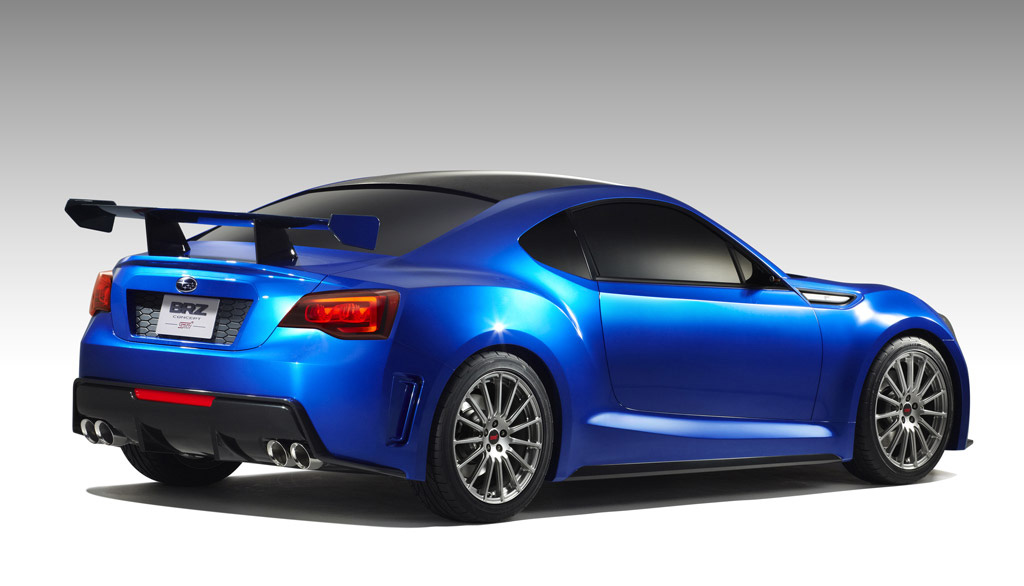
2012 Subaru BRZ finally bows

It's finally arrived: Subaru's version of the long-in-gestation Toyobaru has just said hello to the world at the Tokyo Motor Show. In case you've been in Witness Protection for the past two weeks, we'll recap the major specs: 2,689 pounds, 200 horsepower and 151 pound-feet from the direct-injected 2.0-liter boxer engine, six-speed manual and automatic transmissions on offer and a lower center of gravity than a Ferrari 458 Italia.

There's still no word on pricing yet, but this is the rear-drive sports car that will be working to redefine little, fast, flickable handling. One more thing about the Subie version: it's the only one you can get in this shade of blue. You can refresh yourself on the details in the press release after the jump, and say hello to our newest little friend in the gallery of high-res images.
READ MORE - 2012 Subaru BRZ finally bows

Thursday, September 15, 2011

The Subaru BRZ is still invisible

You can tell how far a concept car is from production by the ratio of glass to its total surface area. Concept cars tend to be airy bubbles of glass which, when faced with the harsh reality of crash standards and production costs, quickly gain the gun slits that modern cars have for windows. By that metric, Subaru’s BRZ—the artist formerly known as the Subieyota—is quite a way from becoming what it hints to one day become: a new SVX.
It’s nothing more at the moment than a lovely Subaru drivetrain in a glass shell. Did you know that Subaru have been making boxer engines since 1966? I didn’t. The BRZ will of course have the latest one.
What it will also have is a very, very low center of gravity, helped by that boxer and, presumably, a yet to be invented technology to make the car’s body from a weightless force field. We’ll see. It’s certainly very low. I wouldn’t want to exaggerate, but almost Miura-low.
It will be the ultimate sleeper if it ever makes it into production with more than a modicum of that glass shell.
READ MORE - The Subaru BRZ is still invisible